Starting Over in Your 40s
Starting Over in Your 40s can feel hard, but this guide shares clear steps, real examples, and mindset shifts to help you rebuild with confidence.
SELF CARE AND PERSONAL GROWTH
Shari Smith
12/19/20258 min read
As an Amazon affiliate, we earn commissions at no extra cost to you if you click our links and make a purchase.
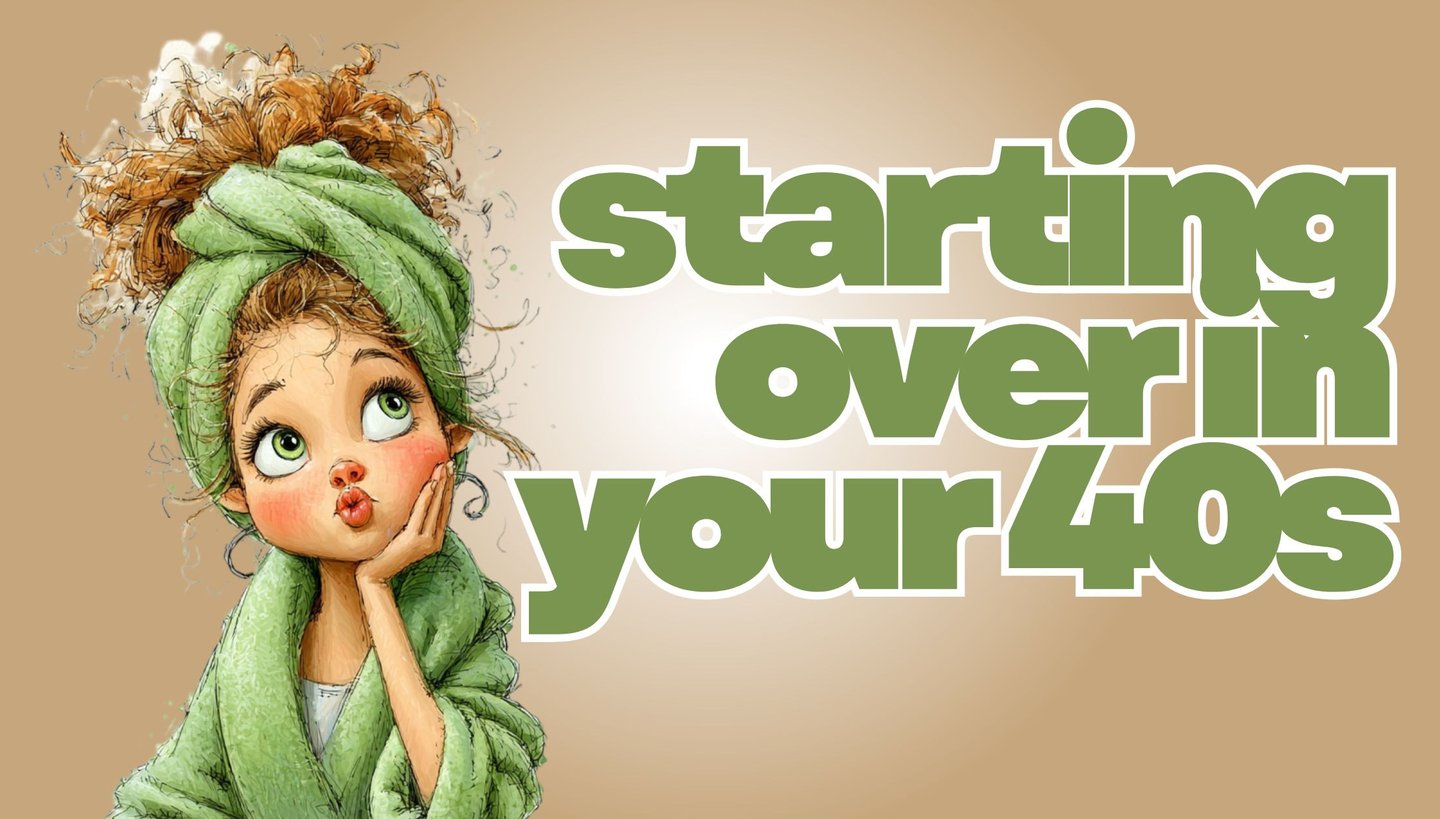
If you are starting over in your 40s, broke, it can feel like you missed your chance. You look around and see people with stable careers, savings, and a clear path, while you are wondering how it all went off track. Mel Robbins has a very different story for you, and it starts with this line: "The 40s were the best decade of my life."
That might sound impossible if you feel like you have wrecked your finances, your career, or your confidence. But her story shows that rock bottom at 40 is not the end, and starting over at 40 can be the start of something much better.

Watch Mel's Story here:
From Rock Bottom to a Turning Point
Mel does not talk about her 40s like a soft landing. She talks about them as the time she went from feeling like a total failure to climbing back up.
At 41, her life looked like a mess.
Here is what was going on all at once:
Her husband's restaurant business was failing.
She had just been laid off from a job she thought would be her big break.
She had changed careers over and over, with around 14 jobs behind her that left her in career burnout.
She described her work history as a "choose your own disaster adventure."
She had already gone through many shifts in her 20s, then seven more pivots in her 30s.
She and her husband had invested all their money into the restaurant, leaving them starting over with no money.
They were in debt, with liens on the house.
She was scared she would never pay for her kids' college.
On paper, it did not look like a rough patch. It looked like a full collapse, far from the typical midlife crisis label.
Emotionally, she felt worse. Her inner voice told her:
"I've completely blown it."
"I'm not just behind, I have messed up everything."
"There is no way I get out of debt."
"There is no way I ever become successful in my career."
She was not just worried about being late. She felt like she had "effed the whole thing up."
If you see yourself in any part of that, you are not alone. Her point is simple and strong: if she could turn that around starting over after 40, you have more room than you think.
The Lie That Keeps You Stuck in Your 40s
There is a quiet story many people carry into their 40s:
If you have not "made it" by 40, you never will.
Mel calls that complete baloney. Her life is proof of that, but she also explains why this lie is so damaging.
When you tell yourself:
"I am too late."
"I should have figured this out by now."
"Everyone else is ahead of me."
"Starting over in my 40s is impossible."
You do not light a fire under yourself. You drain your energy. You start to feel like a loser, not a learner focused on personal growth. That kind of self-talk does not inspire action, it feeds depression and shame.
She pushes back with a different truth. Your 40s are the perfect time to reinvent yourself at 40. You are just getting started.
Look at the math she shares. If the average life expectancy is around 77, and you are 40, you likely have about 37 more years ahead of you.
Ask yourself: How much could you get done in 37 years if you stopped beating yourself up and focused on progress instead?


Your Past Is Fuel, Not Failure
One of the most powerful ideas Mel shares is this: even if your career or money life looks like a disaster, you are not starting from scratch in your 40s.
Every hard job, every bad boss, every wrong turn, every time you quit or got fired, every move you made, all of it has been building experience and transferable skills.
You might have:
Tried many different fields.
Stayed too long in the wrong job.
Chased something that did not work out.
Made money, then lost it.
From the outside, it can look like chaos. On the inside, if you are honest, you know you have learned a lot.
Mel even jokes that she is stubborn and learns lessons the hard way. She sees that as part of her story, not a reason to give up. You may be the same. You may have taken the long way around, but that long way has given you:
A clear sense of what you do not want.
A better sense of what you are actually good at.
Real-world lessons that books cannot give you.
The real shift is in how you talk to yourself.
Instead of, "It's too late," "I'm behind," or "I screwed it all up," she calls those thoughts a stupid lie. They are not facts. They are heavy stories that keep you from using what you already know.
Her message is simple: If I can do it, you can do it.
You are not the first person to hit 40 with a messy past. You are not the only one to feel lost when starting over at 40. The difference comes when you decide to treat your past as raw material for your career transition, not as a verdict on your future.
And in your 40s, you also gain something you did not have in your 20s or 30s: urgency. You feel time in a different way. That feeling can scare you, or it can sharpen you for starting over after 40.
As she puts it in spirit, your 40s are not the finish line. Your 40s are the launch pad for the next decade of your life.
Success Stories: It Is Never Too Late
Mel does not just rely on her own story. She points to well-known names who hit their stride later in life.
Vera Wang began starting a new career designing wedding dresses at 40. Before that, she had other careers. The thing she is now known for did not begin in her 20s.
Samuel L. Jackson landed his breakout role in Pulp Fiction at 45, highlighting a pivotal midlife career change. That was not the start of his acting, but it was a major turning point that most people remember him for.
Julia Child published her first cookbook at 49 after finding your passion for French cooking. The version of her that people picture, the famous French cooking expert, came into the spotlight close to 50.
These examples are not meant to make you feel small. They are meant to show you that a late start is still a start. What matters is not when you begin, it is that you begin.
By the time you reach your 40s, you are not empty-handed.
You have:
A network of people you know.
Years of trial and error.
Skills you picked up without even giving yourself credit.
A list of mistakes you never want to repeat.
Mel's advice is to triple down on this decade and go for it. Use what you have in front of you instead of staring at what you wish you had done earlier.
Why Your 40s Are the Launchpad for Something New
Your 40s come with a strange kind of freedom.
On one hand, many people your age are very busy. They are raising kids, managing a serious career, or dealing with aging parents. People are wrapped up in their own lives.
That means something surprising: no one is watching you as closely as you think.
You have space to try things like starting a new career, experiment, and change direction, and most people will be too focused on themselves to judge you. You also find that you do not care as much about what others think either. That is a gift.
Mel adds another key point. Maybe the reason things have not worked out yet is that you are not meant to just fit into someone else's company or plan. Maybe your 40s are the decade where you finally build your own online business.
She backs this with research from a study at MIT Sloan School of Business. The average age of a successful startup founder is 45. This makes your 40s an ideal time for starting a new career through entrepreneurship.
Why would that be the case? She breaks it down in a simple way.
By your mid-40s, you usually have:
Lifelong learning from years of trial and error.
Failure that has toughened you and taught you what does not work.
Clarity about who you are and what you want to spend your life on, developed through self-assessment.
A better sense of your strengths and real interests.
A short fuse for nonsense because you are sick of the BS, which helps you focus.
In her own life, it was in her 40s that she got tired of listening to her excuses. She stopped waiting for the perfect moment and forced herself to do what needed to be done.
You can treat your 40s the same way. A time to cut the noise, stop pretending, and point your time and energy at what actually matters to you.


Your 40s Are an Invitation to Take Control
There is a clear invitation in everything Mel shares about this decade.
If you do not like where you are, stop listening to your excuses. Embrace a lifestyle change and use your 40s to transform your life instead of replaying your regrets.
If you have been secretly hoping someone will show up and rescue you, she has hard but kind advice: stop gaslighting yourself. No one is coming to save you, but mental health support can be a valuable resource as you take action. That is not meant to crush you. It is meant to set you free.
When she hit rock bottom, she had a choice. She could keep feeding the story that she was broken and doomed, or she could test her own strength. That low point forced her to see that she had more capacity than she thought.
You have the same capacity. It does not matter if you feel successful on the outside or like everything is falling apart.
Your 40s are a chance to build your skills in coping with change and to:
Get honest about what is not working.
Take responsibility for what you want next.
Decide what you refuse to keep tolerating, such as neglecting your self-care routine or physical wellbeing.
If you like simple steps, you can think of it like this, perhaps starting with a vision board to map your direction:
Own your path: Stop comparing your life to anyone else's timeline.
Use your urgency: Let the feeling that time matters now push you to act, not freeze.
Launch forward: Pick one bold move that lines up with who you are now, and start there.
You do not have to overhaul your whole life in one year. You just have to stop telling yourself that you are finished.
Final Thoughts: Your Next Decade Starts Here
Mel Robbins did not arrive in her 40s with a flawless story. She arrived broke, scared, and convinced she had wrecked her life, then used that decade to rebuild through financial planning and building resilience on the path to financial stability. Her message is not that it is easy. Her message is that it is possible.
If you are starting over at 40, you are not behind. You are standing at the start of a new stretch of years that can look very different from what came before. You have experience, a network, hard-earned wisdom, and a sharper sense of what matters in areas like financial stability, dating in your 40s, or rediscovering your true self.
The question now is simple: what are you going to do with this decade?
Start with one honest decision, one small risk, one step that treats your 40s as a launch pad for new beginnings, not a limit. Embrace this fresh start; your future self will be glad you chose to start now.